
Christine Boynton March 12, 2024
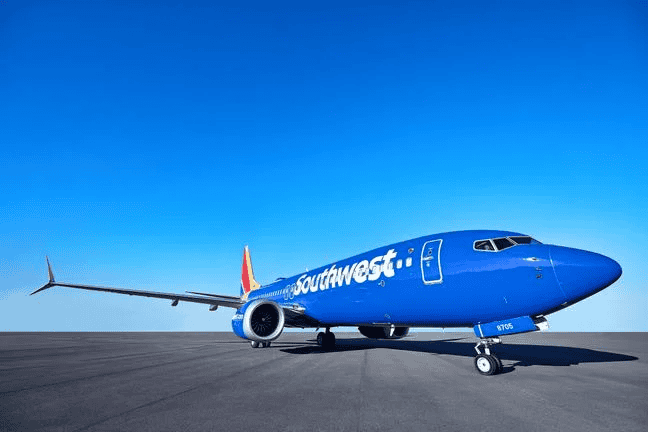
Credit: Southwest Airlines
Southwest Airlines still sees transitioning away from a single fleet type as cost-prohibitive despite the benefits that could present in lessening its dependence on Boeing, CEO Bob Jordan said at an investor event.
“We have calculated the cost of transitioning to multiple fleet types, and I’ll just tell you that it’s significant,” Jordan said, calling it a “big leap to move beyond” that single type. While the famously all-737 operator continues to have regular and “very rigorous discussions with Boeing and with Airbus,” to compare its options, it ultimately sees no easy solution as it detailed the latest impacts of ongoing delays.
“There is no such thing as derisking your fleet plan,” Jordan said at the JP Morgan Industrials Conference on March 12. “Even at best you might be 50/50; parking 50% of your fleet or 30% of your fleet is disastrous, so I think the idea that you can fully derisk your deliveries or your fleet plan is a fallacy.”
Newly updated guidance from Boeing projects 46 737-8 deliveries for Southwest in 2024, 12 fewer than previous expectations.
“It is not unlikely that that ’46’ number changes,” noted Jordan. “It’s not unlikely that that creeps into [20]25, there’s just a lot to do.”
The Dallas-based airline no longer expects delivery of any 737-7s in 2024, having previously expected to receive 21 of the still-uncertified variant this year, though it had already excluded the type from its 2024 schedules.
Given the news of further delays, Southwest is “actively and urgently” focused on cost and capacity reductions. The impact of updated capacity plans, still fluid, are expected to be primarily focused on post-peak summer schedules. Full-year capacity may grow – at most – between 4.5-5% year-over-year, it said, down 1-1.5 points from prior expectations due to the impact of delays.
“We’re still in the process of determining our internal planning assumptions around the number and timing of deliveries that we will plan around,” Jordan said.
Staffing capacity will also take a hit. Southwest has already stopped hiring for the group supporting its reservations team, and in April will stop pilot and flight attendant hiring classes, reducing its hiring for pilots in 2024 by more than 50%, and flight attendants by more than 60%, its CEO detailed. Southwest plans to end the year “solidly down” in staffing when compared to 2023, Jordan said, with evaluations ongoing for additional cost-reduction opportunities.
Southwest did not provide a 2024 outlook, as it adjusts to the new delivery expectations and formulates a plan to mitigate the risk of any further reductions.
“Boeing needs to become a better company, and the deliveries will follow that,” Jordan said. “A reliable Boeing, a Boeing that cannot just deliver, but deliver with quality, is good for all of us, and that’s where my whole focus is right now at this point.”
United’s Perspective
United Airlines, Boeing‘s biggest customer of 737-10s, has already taken the largest MAX variant out of its fleet plan and further detailed what that step means for Boeing. “We’ve asked Boeing to stop building MAX 10s – which they’ve done – for us, and build MAX 9s,” CEO Scott Kirby said at the conference.
“If and when the MAX 10 gets certified – we’ll convert them back to MAX 10s. MAX 10s are out for us until it gets certified,” he added, describing the timeline for certification as “impossible to say when.”
The airline expects to take delivery of 56 MAXs (37 737-8s, 19 737-9s) in 2024, and 21 in 2025 (six – 8s and 15 – 9s). It is currently “in the market” for Airbus A321s, Kirby confirmed.
An A321 order could be announced “if we get a deal [where] the economics work,” the CEO described. “Then we’ll do something. If we don’t, then we won’t, and we’ll wind up having more MAX 9s.”
Looking ahead, Kirby said he was confident his airline would get the amount of lift necessary, with enough flexibility and time to “get to the number of airplanes without feeling under the gun – need is not the word I would ever use,” he added.
Meanwhile, with orders for the – 8 and – 10 variant, American Airlines said it had no exposure to the MAX 10 until 2028 and beyond. Detailed during a recent investor day, the carrier expects 20 MAX deliveries in 2024, 14 in 2025, 10 in 2026, and 20 in 2028, while noting “sufficient Airbus option positions” to execute in case of delays.
“We’re at a point right now where we’re really certain on our aircraft deliveries now and in the future,” CEO Robert Isom said.

Christine Boynton is a Senior Editor covering air transport in the Americas for Aviation Week Network.