Sean Broderick January 09, 2024
Credit: NTSB
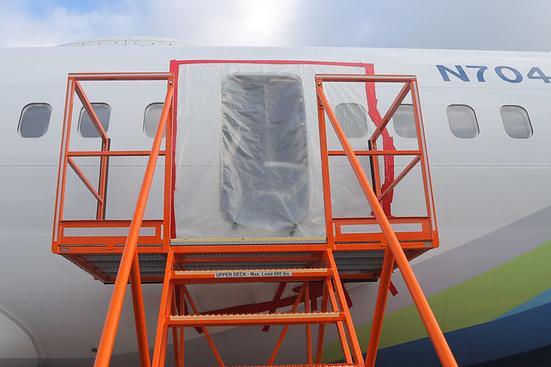
The exit door plug at the center of the Jan. 5 Alaska Airlines accident pivoted up and broke away from the Boeing 737-9 in flight, an NTSB investigator said late Jan. 8, suggesting that bolts needed to keep the insert in place failed – meaning they either worked their way free or were never installed.
Initial examination of the recovered door plug and the hole left in the airframe when the part blew out showed that two guide roller tracks, one on each side near the plug’s top, were fractured, NTSB engineer Clint Crookshanks said in a media briefing. The fractures did not cause the plug failure, but happened as the panel broke away, he added.
While the plug is fixed in place during normal operations, it is designed to move for routine maintenance inspections and to aid initial installation.
Credit: NTSB via Boeing
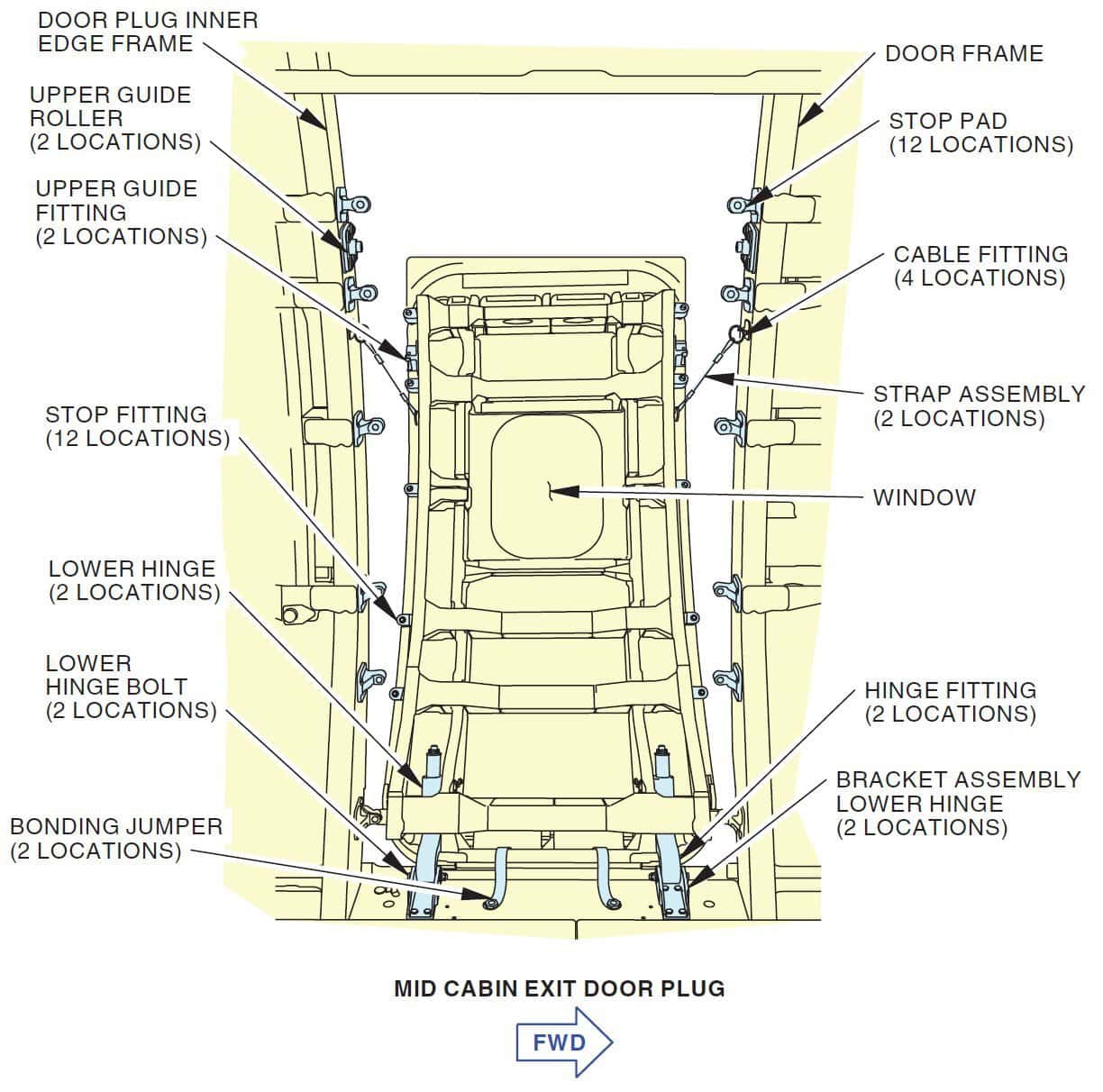
The plug’s design includes 12 “stop fittings” that keep the insert from moving outward. When the plug is in place, fittings on it match up with fittings around the frame, with the plug fittings resting on the cabin side of the frame fittings, preventing the insert from moving outward.
Two hinges along the plug’s bottom and two guide roller fittings – one on each side of the plug near the top that fit into rollers attached to the frame – allow the insert to move up so its fittings can clear the frame fittings. But movement is possible only if bolts in each hinge and guide roller assembly are removed. Without the bolts, an installed plug can move upward and pivot out slightly and return back in and down to its fixed position.
Figuring out what happened to the four bolts on the Alaska accident flight airplane is emerging as a key task in NTSB’s probe.
“The exam to date has shown that the door [plug] in fact did translate upward [and] all 12 stops became disengaged, allowing it to blow out of the fuselage,” Crookshanks said. “We have not yet recovered the four bolts that restrain it from its vertical movement and we have not yet determined if they existed.”
Crookshanks said closer examination of the plug and other parts will reveal if each bolt worked itself free, failed, or was never installed.
NTSB Chair Jennifer Homendy said it is too early to determine if initial findings from airlines conducting FAA-mandated 737-9 plug assembly inspections following the accident point to a broader problem. Both Alaska and United Airlines said preliminary inspections revealed loose bolts and other possible discrepancies.
“We’re really focused on this aircraft,” she said. “We need to first and foremost figure out what happened here on this aircraft. If we have a bigger system-wide or fleet issue, we will issue an urgent safety recommendation to push for change. With that said we are aware of the reports of that are coming back from the inspections… Our team is collecting that information and there will be some follow up.”
Alaska, United, and other affected airlines on Jan. 8 received detailed, FAA-approved instructions from Boeing on how to conduct the checks. Each airline must have its process approved by the FAA before conduction the inspections. In the meantime, all 737-9s with the plug blocking unneeded emergency exits remain grounded.
Meanwhile, Homendy provided more details on the accident flight’s timeline based on flight data recorder (FDR) data. Alaska Flight 1282 departed Portland, Oregon, for Ontario, California, at 5:06 p.m. local time Jan. 5. Six minutes later, with the aircraft at 14,800 ft., the cabin pressure dropped sharply, signaling that the plug broke away, triggering a rapid decompression. A master caution warning activated immediately.
The aircraft kept climbing for about 50 sec., reaching 16,320 ft., before beginning a rapid descent.
At 5:26 p.m., the aircraft was back on the ground at Portland following an emergency landing. None of the 171 passengers and six crew were injured.

Senior Air Transport & Safety Editor Sean Broderick covers aviation safety, MRO, and the airline business from Aviation Week Network’s Washington, D.C. office.