
Christine Boynton April 28, 2026
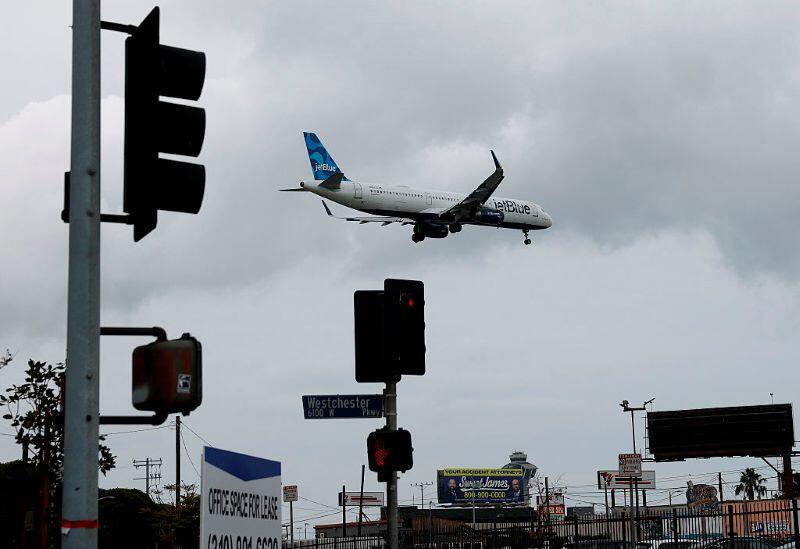
Credit: Justin Sullivan/Getty Images
JetBlue Airways is not ruling out the possibility of government support, describing the current fuel environment as the most significant headwind the industry has faced since the COVID-19 pandemic.
Compared to the U.S. budget carriers seeking federal aid, JetBlue is “in a bit of a different position, because we have a very healthy, unencumbered asset base and strong liquidity,” CEO Joanna Geraghty told investors and analysts on an April 28 earnings call. “Never say never,” she tempered. “We’re open to anything and everything, assuming the terms would make sense for JetBlue.”
For now, the carrier remains focused on JetForward, a multi-year roadmap to profitability, and on implementing Blue Sky, the loyalty-linking and interline partnership it announced with United Airlines last spring. Blue Sky’s launch followed repeated attempts by JetBlue to gain scale, including through a failed merger with ULCC Spirit Airlines and a now-dismantled Northeast Alliance (NEA) with American Airlines. Both arrangements were blocked by separate antitrust rulings under the prior Biden Administration, which “contributed to a disadvantage in the industry,” Geraghty said. “I think that’s obviously contributing to a sector that is less resilient, compared to some of the larger carriers.”
Though speculation surfaced in March that JetBlue was again exploring the viability of a merger, the airline cited continued confidence that ongoing initiatives are the right path forward.
“We recognize the importance of scale,” Geraghty said on the call. “That’s why we tried to do the NEA, that’s why we tried to do the Spirit merger. Now we’ve pivoted and we’re focused on Blue Sky.” Rather than rely on the government, “we’re focused on what we can control,” the CEO said. “That’s where Blue Sky comes in, our network and our loyalty platform, and how we continue to accelerate those.”
JetBlue has now joined several U.S. airlines in suspending prior full-year guidance amid high and volatile oil prices. Every $0.10 increase or decrease in fuel price equates to about $85 million of expense for the full year, its CFO told investors.
Having already raised fares and cut capacity to navigate the environment, the carrier is pursuing additional cost-saving opportunities and further reducing its flying during off-peak periods, facing expected second quarter fuel prices in the range of $4.13 to $4.28. The midpoint of that range is 75% higher than the year-ago period. Before conflict in Iran caused fuel costs to spike, JetBlue’s first quarter was already 90% booked, giving it limited ability to raise fares. Looking ahead, it expects 30-40% fuel recapture in the second quarter and plans to achieve 100% by early 2027.
Citing continued uncertainty, JetBlue is planning for multiple fuel price scenarios in the months to come. Earlier in April it raised $500 million in debt financing secured against owned Airbus A320 and A220 aircraft, with an ability to access another $250 million if needed.
“It’s anybody’s guess where fuel is going to be for the remainder of the year into next year, so we’re trying to be flexible,” Geraghty said.
For the first quarter, JetBlue reported operating revenues of $2.2 billion, up 4.7% year-over-year, on a 6.5% uptick in total operating expenses. It recorded a net loss of $319 million, versus a $208 million net loss recorded in the year-ago period.
“This was historic quarter for our loyalty program,” JetBlue president Marty St. George noted, with loyalty cash remuneration up 19% year-over-year, driven by double digit spend growth on its co-brand credit card, and a 45% increase in card acquisitions. Blue Sky is driving co-brand signups in non-focus city geographies, he said.
In the second quarter, JetBlue expects capacity to be up in the range of 1.5-4.5% year-over-year, forecasting unit revenues will grow 7-11%, on continued demand strength. Noting a “slight shift” to its A220 deliveries, the carrier now expects to receive 12 in full-year 2026, down from January guidance of 14.
In the second half of the year, JetBlue plans to reduce capacity by at least 2-3 points and remains on track to begin selling domestic first class during that period, a product currently going through the certification process. All of the carrier’s June quarter capacity growth will be driven by Fort Lauderdale, where it has steadily ramped up its levels of flying as budget rival Spirit pulls back.
“We will absolutely continue to build Fort Lauderdale to the extent we can,” St. George said. The New York-based carrier hopes to grow its presence to the size of its Boston hub, gate-willing. “Instead of two focus cities holding us up, we’ll have a third leg of the stool, in Fort Lauderdale.”

Email: Christine.Boynton@aviationweek.com
Christine Boynton is a Senior Editor covering air transport in the Americas for Aviation Week Network.