
Sean Broderick November 25, 2024
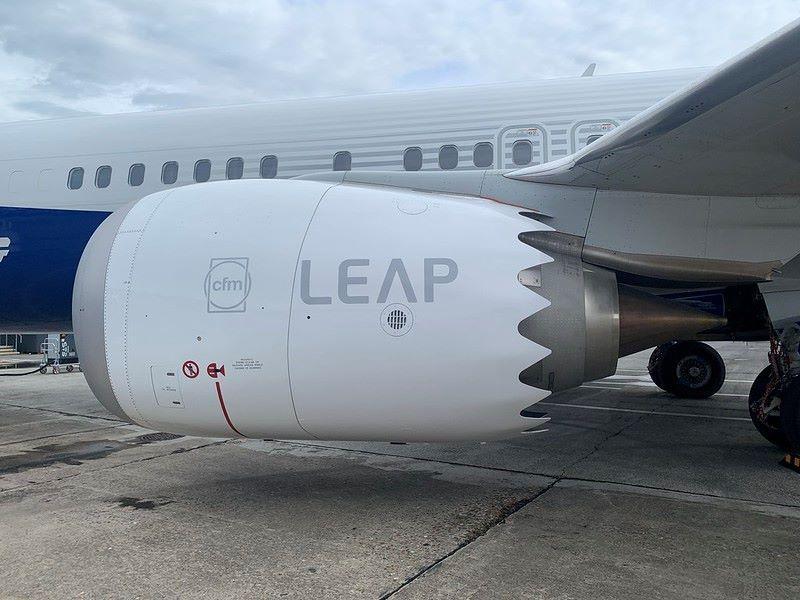
CFM Leap 1-B engine
Credit: Sean Broderick/AWST
The NTSB’s decision to open a formal investigation into a December 2023 bird strike involving a Southwest Airlines Boeing 737 MAX 8 will add scrutiny to the rarely needed safety device triggered during the incident that some FAA experts and pilots believe creates unacceptable risk.
The board’s Nov. 22 announcement of a formal probe into the “bird strike and subsequent smoke in cockpit event” comes three weeks after the FAA’s Office of Accident Investigation & Prevention (AVP) detailed its concerns over the CFM Leap-1B’s load reduction device (LRD) in an internal memo. The memo directs six safety recommendations at the FAA based on AVP’s examination of the December 2023 incident and a similar one involving another Southwest 737-8 departing Havana in March 2023 in which both aircraft suffered broken fan blades after striking large birds.
In its memo, AVP calls for both immediate and long-term actions to minimize risks – principally smoke in the cockpit – that an LRD activation presents.
Found on many engines, LRDs reduce dynamic loads transferred from a severely damaged fan to surrounding structure, including the engine pylon. On the Leap, fuse bolts break away and disconnect the fan rotor from the engine core.
On the Leap-1B, an LRD activation also opens an oil sump, releasing oil into the engine flow path ahead of pneumatic bleed ports that divert air to the aircraft for pressurization and temperature control. The No. 1 engine’s air conditioning pack primarily supplies the cockpit, while the No. 2 engine’s pack supplies cabin air.
AVP’s position is that industry has not responded sufficiently to the two Southwest incidents. Boeing issued an operators’ bulletin in early February, explaining that a severely damaged engine can be accompanied by smoke in the cockpit or cabin, and pilots should follow a specific non-normal checklist (NNC). Several operators, including American Airlines and Southwest, issued bulletins to their pilots reiterating Boeing‘s instructions, but stopped short of procedural or training-related changes.
The applicable NCC, the Engine Fire or Severe Damage or Separation (EFSDS) list, is not a required memory item, meaning pilots must reference a quick-access card or similar source to follow the steps.
Among the concerns AVP cites is a Boeing analysis that shows an LRD activation can reduce flight deck visibility to 5 in. within 30 sec. if the valve is not closed. This gives pilots a narrow window to keep the cockpit air clear.
Another issue: the 737 MAX lacks a modern flight crew alerting system that could direct pilots to the correct checklist based on automatically detected parameters. Absent automatic logic that other aircraft flight decks incorporate, 737 MAX pilots must process multiple cues to determine when an engine failure includes “severe damage” and subsequent LRD activation.
One airline’s EFSDS checklists advises pilots to use it when “one or more” of several conditions occur, including an engine fire warning and “airframe vibrations with abnormal engine indications.” Depending on the severity of the damage, the conditions may or may not be immediately obvious.
“[LRD activation] presents itself buried under a bunch of different things,” said Dennis Tajer, spokesperson for Allied Pilots Association and a 737 captain at American Airlines. “You have to analyze it, and you’re doing it when you’re close to the ground and your job is just to get the aircraft cleaned up. Then the [LRD] dumps a bunch of smoke into your office.”
AVP’s short-term suggestion is to prohibit 737 MAX departures with the No. 1 pack on.
The Cockpit Companion, an unofficial source for 737 system functionality used by many pilots to augment their flight manuals, published an update on the LRD. In it, authors Bill Bulfer and Robert Dorsett suggest mitigating the smoke risk by using the auxiliary power unit to provide bleed air on departure – an already approved procedure. The update also suggests adding a new memory item to two NNCs–the EFSDS and Engine Failure or Shutdown lists. The action: close the related bleed switch.
A pilot at another large 737 MAX operatorwho first brought the LRD issue to the FAA earlier this yearandhas flown 737s for more than 30 years is proposing a different approach covering more scenarios. This pilot’s solution: add a new, memory-item step to the beginning of the 737 MAX EFSDS that instructs pilots to shut off the affected bleed air switch. The rest of the checklist does not have to become a memory item – only the new, first step, the pilot emphasizes.
The change, which has yet to be formally presented and would require FAA approval, addresses severe engine damage occurrences in any flight phase, the pilot said.
While bird strikes on departure caused the Southwest incidents, other failures could trigger LRD activations, the pilot said. Among them: the engine anti-ice problem and potential severe engine inlet cowl damage flagged by the FAA in an August 2023 airworthiness directive, the pilot added.
“This will stop smoke from entering the aircraft through the bleed air system, thereby preventing a compound emergency” that couples a major engine failure with onboard smoke, the pilot told Aviation Week.
There are several parameters that will automatically close the bleed air shut-off valve, including the high-pressure engine spool (N2) slowing down to a specific speed following an LRD activation. But flight data recorder (FDR) data from the two Southwest bird strikes analyzed by AVP suggests timelines can vary significantly.
In the Havana incident, the crew toggled the affected No. 2 engine’s start lever to CUTOFF – which closes the affected bleed valve – 1 min., 16 sec. after the bird strike. In the New Orleans incident, the engine spooled down quickly following the strike and the affected valve closed within 16 sec.
“Despite the… closure within 16 seconds, this was not quick enough to preclude a toxic amount of smoke and fumes to enter the flight deck in high concentrations,” the AVP memo said. “During an LRD activation event, automatic bleed [valve] shutdown cannot be relied upon with the current system shutdown logic. This is due to the amount of time required for N2 core speed to reduce, coupled with the possibility that the engine could attempt to continue relight procedures.
“The worst-case scenario is a left engine (Number 1) bird strike with LRD activation and without automatic [valve] closure, which would reasonably lead to higher flight deck smoke concentrations,” the AVP memo added.
The memo also expressed concern with risk created by pilots donning oxygen masks following a bird strike close to the ground, where the majority of them take place.
“It is not rational to expect flight crew to be able to don oxygen masks and smoke goggles during a critical phase of flight such as rotation and liftoff,” the memo said. The New Orleans bird strike occurred 16 sec. after liftoff, the memo noted.
The NTSB’s probe will take place alongside an FAA review board the agency plans to convene in the coming days “to examine the data and develop a path forward,” the agency said Nov. 21. Both are expected to examine AVP’s analysis and conclusions as part of their work. Their conclusions also will likely determine whether any changes to the LRD’s design or related software logic are needed based on fleet risk analysis.
In the meantime, the most extensive action operators have taken is reiterating Boeing‘s message and established protocols.
“Our existing procedures are designed to manage smoke-related events effectively, and we are fully prepared to take any additional steps as directed by the FAA, NTSB, or other safety regulators,” Southwest said in a Nov. 21 message to employees. “Internally, our safety management system ensures that we are systematically addressing this issue while engaging with the appropriate stakeholders.”
This story has been updated with additional details.

Senior Air Transport & Safety Editor Sean Broderick covers aviation safety, MRO, and the airline business from Aviation Week Network’s Washington, D.C. office.