
Christine Boynton May 08, 2024
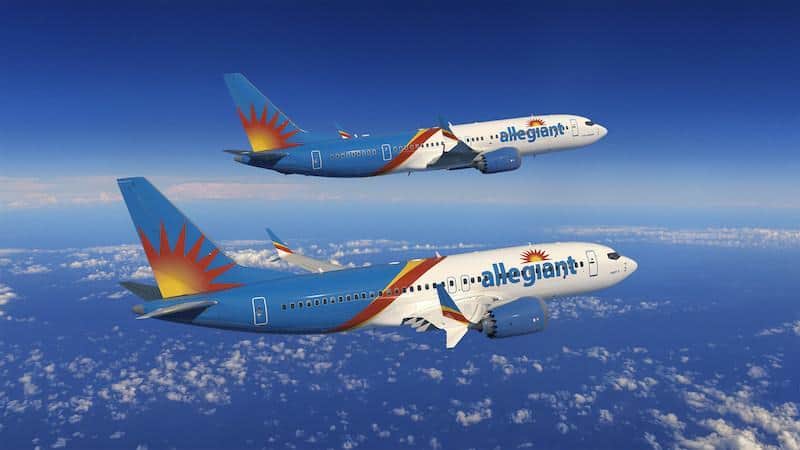
A rendering of Allegiant’s incoming 737 MAX aircraft.
Credit: Allegiant Travel Company
Boeing delivery delays continue to hamper Allegiant Air, as the ULCC no longer anticipates placing any MAX aircraft into service during the first half of 2024.
It now expects its first Boeing 737-8-200 to enter revenue service during the third quarter (Q3).
At the time of its last earnings call in February, the Las Vegas-based carrier was anticipating its first MAX in late March or early April, an aircraft it says is still awaiting U.S. FAA inspection.
The FAA has been inspecting and issuing final airworthiness certificates for all 737 MAXs since the fleet was ungrounded in December 2020. Allegiant’s first MAX is not only a new type for the operator, but also the first 737-8-200 being delivered to a U.S. operator.
Allegiant now projects it will receive six by the end of 2024, halved from prior expectations.
“This estimate is not based on guidance from Boeing but rather represents our best estimate based on information available to us today,” CFO Robert Neal told investors during a May 7 earnings call. The carrier is working with Boeing to devise an orderly delivery schedule, which it says may moderate its capacity growth in the short to mid term. The carrier has trimmed its full-year capacity guide by one point – expecting to be up by 3% over 2023.
Executives said they are incurring significant expenses as they wait for deliveries to begin.
“Prior to this brand-new type of aircraft entering the Allegiant fleet, we hire and train pilots, we plan our network and we take on other preparation and infrastructure costs,” President Greg Anderson said. “These material headwinds are at a current run rate of roughly $30 million annually to operating income.”
The ULCC announced its order for 50 737-7s and 737-8-200s plus options for 50 additional jets in early 2022, before expanding those options to 80 and converting six – 7 positions to the – 8-200 variant in Q3 2023. It had expected to take delivery of the first by the time of its Q4 2023 earnings call.
An in-service MAX fleet operating at scale will be a key driver in returning to industry-leading margins, Anderson said. It will also require an increase in peak flying – still 20% below 2019 levels – but with improved pilot hiring and attrition levels now allowing for full restoration by 2025. Implementation of its Navitaire reservation system will also contribute, he said, an upgrade offering “critical new features over our legacy homegrown system,” including the ability for international expansion.
In Q1 the company recorded airline operating revenue of $632.5 million, down 2.6% year over year, on a 10.2% increase in airline operating expenses. Airline net income was $11.4 million, compared to year-ago airline net income of $59.9 million. Allegiant Travel Company recorded total operating revenues of $656.4 million for the quarter, up 1% year over year, on a 15.5% increase in total operating expenses, reporting a net loss of $919,000 versus year-ago net income of $56.1 million.
Allegiant’s Q1 adjusted airline-only operating margin of roughly 6% would have been approximately 13%, Anderson said, had it not been for headwinds such as Boeing delivery delays; delayed pricing functionality during Navitaire integration; and lower aircraft utilization in peak demand periods. He described 2024 as a transitional year for the company.
Looking ahead, the carrier expects to achieve an airline-only operating margin of 7%-9% in Q2, and earnings per share of $1.25-$1.75, excluding special charges.
“The airline problems we are currently experiencing can be addressed for the most part during the remainder of this year and into 2025,” said CEO Maurice Gallagher. “By then we should be hitting our stride.”
Christine Boynton Christine Boynton is a Senior Editor covering air transport in the Americas for Aviation Week Network.